Companies have poured billions into chatbots. The market exploded from $370 million in 2017 to $2.2 billion in 2024. Every business seems convinced that customers want to type their problems into a text box.
But here's what the data actually shows: 71% of customers still prefer talking to a human agent rather than interacting with a chatbot. And when it comes to actually closing sales and bookings, phone calls convert at rates 10-15x higher than web leads.
This isn't nostalgia or technophobia. It's neuroscience. The human voice triggers trust mechanisms in our brains that text simply cannot replicate.
SEE IT IN ACTION
Not Your Father's
Phone Tree.
Modern AI vs Old Stereotypes
AI sounds too robotic for my business. You are thinking of the old system. Press one for sales. Your call is important to us. Please hold. That is not what modern AI phone agents do. They have real conversations. They understand context. They book appointments, take payments, and answer questions - in 26 languages. And they sound natural enough that most callers do not realize they are talking to AI. Customer satisfaction after switching to AI phone agents: 4.6 out of 5.
The Numbers Don't Lie
Despite massive corporate investment in text-based automation, customer preferences haven't shifted:
Phone calls influence over one trillion dollars in U.S. consumer spending every year. That's not a rounding error, it's a fundamental reality about how humans make buying decisions.
Why Text Falls Short: The Chatbot Frustration
Businesses love chatbots because they're cheap and scalable. But customers tell a different story:
😤 Why Customers Hate Chatbots
The chatbot market keeps growing because businesses benefit from cost reduction. But customers? They're voting with their preferences and overwhelming choosing voice.
The Neuroscience of Voice
Why do humans prefer voice communication? The answer lies in how our brains evolved over millions of years.
🧠 What Happens in Your Brain During Voice Communication
- ⚡ Neural coupling: During effective voice communication the brain waves of speaker and listener literally synchronize. Princeton neuroscientist Uri Hasson describes communication as "a single act performed by two brains."
- 💜 Oxytocin release: Voice triggers the "trust hormone" oxytocin, which increases feelings of connection and cooperation. Text doesn't activate this response.
- 🎭 Emotional decoding: The auditory cortex and limbic system work together to decode tone, pitch and rhythm, inferring emotional states within milliseconds.
- 👶 Innate recognition: Even infants respond to emotional voice tone, proving this is hardwired, not learned behavior.
Dr. Kumar's research found that even when people expected text communication to be more comfortable, they actually felt more connected and no more awkward after voice calls. Our intuition about preferring text is simply wrong.
Voice Creates Stronger Bonds
Research consistently shows that voice communication builds trust and connection that text cannot replicate:
Perceived Connection Strength by Communication Method
🔗 Why Voice Builds Trust
When you hear someone's voice, your brain processes thousands of micro-signals: confidence levels, emotional state, sincerity and competence. These judgments happen automatically and unconsciously. Text provides none of these signals, forcing customers to make decisions with incomplete information.
High-Stakes Purchases Demand Voice
The more money at stake the more customers want to talk to someone. This pattern holds across every major purchase category:
Insurance
Most likely to call when making insurance purchases
Healthcare
Prefer phone for medical decisions and appointments
Telecommunications
Call for plan comparisons and service changes
Automotive
Need voice for vehicle purchase decisions
Home Services
Call for repairs, renovations and quotes
Travel
Phone for complex itineraries and high-value bookings
For tours, charters and experience-based businesses the pattern is clear: customers call when they're ready to buy. They text or chat when they're just browsing.
Why Customers Call (Not Chat)
Research reveals the specific motivations driving phone behavior:
Primary Reasons Customers Choose to Call
The top reasons, research, high-stakes comfort and human connection, all point to the same conclusion: when decisions matter, people want voice.
The Human Connection Factor
68% of consumers say they find the human connection aspect of calling businesses attractive and prefer it over any other channel, including chat and email.
📞 Real-World Scenario: Booking a $500 Fishing Charter
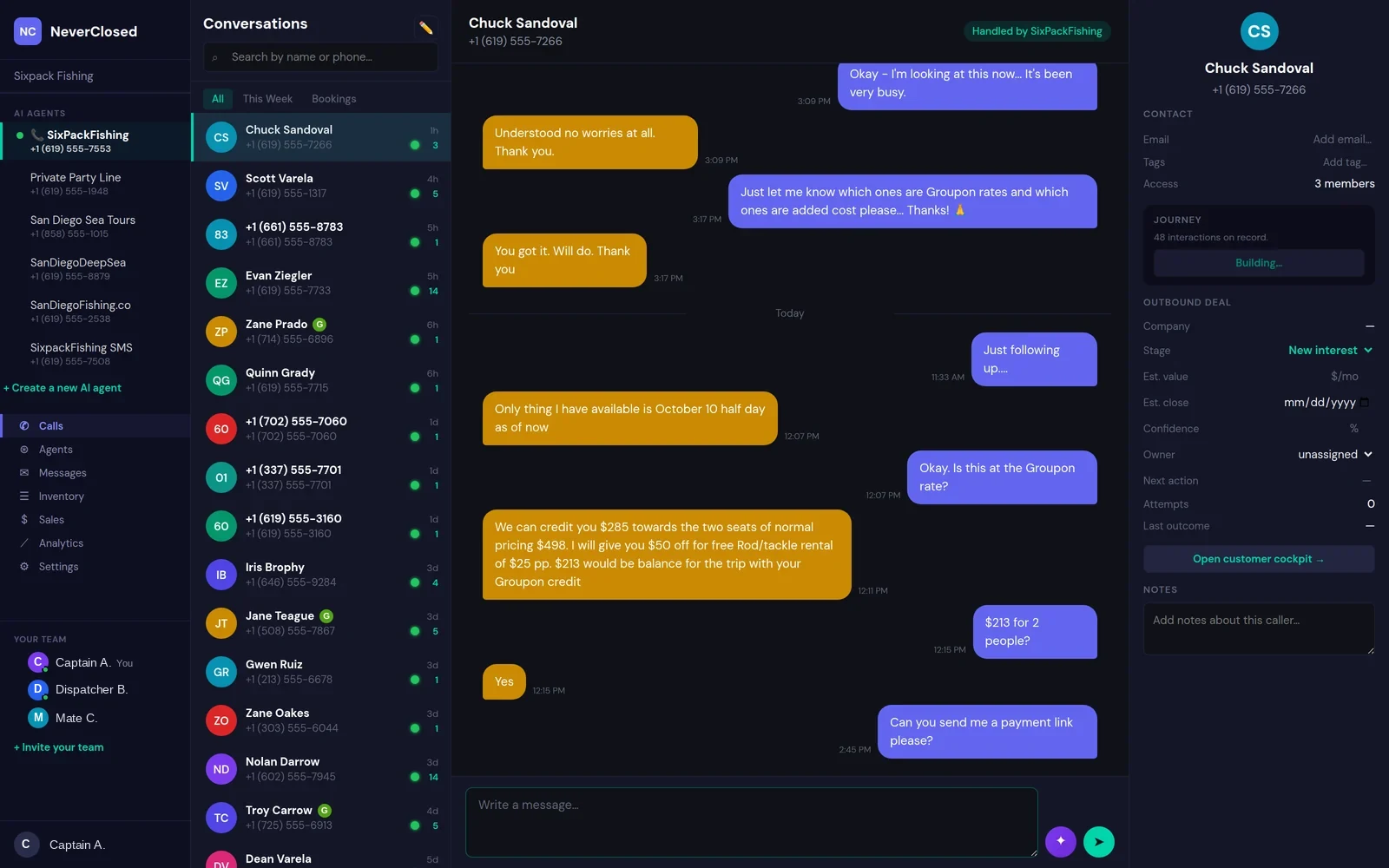
"What dates are available?" ... "Is that deep sea?" ... "How many can come?" ... "Is lunch included?" ... "What's your cancellation policy?" ... [20 minutes of back-and-forth, customer abandons]
"Hi! Looking to book a trip for 4 people, September weekend, want to catch yellowfin. What do you recommend?", Captain responds with personalized recommendation, answers questions in real-time, books the trip in 4 minutes.
The Conversion Gap
Here's where the psychology translates to revenue:
Lead-to-Booking Conversion Rate by Channel
💰 What This Means for a Tour Operator
Voice Benefits Beyond Conversion
High conversion is just the beginning. Voice communication delivers advantages text simply cannot:
Complex Handling
Voice resolves multi-part questions in seconds that would take dozens of chat messages
Emotional Intelligence
Detect and respond to customer anxiety, excitement or hesitation in real-time
Universal Access
No typing required, accessible to elderly, disabled and on-the-go customers
Speed to Resolution
Average phone call resolves in 4-6 minutes vs. 20+ minutes of back-and-forth chat
Trust Building
Voice triggers oxytocin release, creating emotional connection text can't replicate
Higher Value Sales
Customers are 30% more comfortable making high-stakes purchases over phone
The AI Voice Revolution
Here's where it gets interesting: AI voice agents combine the psychology of human voice with the scalability of chatbots.
| Capability | Chatbots | Human Staff | AI Voice Agents |
|---|---|---|---|
| Triggers trust response | ✗ | ✓ | ✓ |
| Handles complex questions | ✗ | ✓ | ✓ |
| Available 24/7 | ✓ | ✗ | ✓ |
| Consistent quality | ✓ | ~ | ✓ |
| Emotional detection | ✗ | ✓ | ✓ |
| Scalable to volume | ✓ | ✗ | ✓ |
| Cost per interaction | Low | High | Low |
Modern AI voice technology doesn't sound robotic. It sounds natural, engaging, and, critically it triggers the same psychological trust responses as human voice.
What Smart Businesses Are Doing
Leading companies are repositioning their customer communication strategies based on this research:
- Making phone the primary channel for booking inquiries rather than hiding it behind chat widgets
- Using AI voice agents to capture the 60-80% of calls they currently miss
- Reserving chatbots for low-stakes tasks like order status and FAQ deflection
- Measuring actual conversions rather than "engagement" metrics that hide chat's poor performance
- Training staff to understand that voice calls represent their highest-intent, highest-value prospects
"In these high-stakes transactions, consumers want to feel confident that they are making the right buying decision. Offering a human touch is the best way to provide that reassurance and build rapport."
The Bottom Line
The psychology is clear: humans are wired for voice communication. Text is convenient for businesses but frustrating for customers. Phone calls build trust, enable complex conversations and convert at dramatically higher rates.
The question isn't whether your customers prefer voice the research is overwhelming. The question is: are you capturing those calls or letting them go to voicemail?
With AI voice agents, you can have the best of both worlds: the psychological power of voice communication with the 24/7 availability and consistency of automation.
Your customers already want to call. Make sure someone answers.
Hear the Difference Yourself
Call our AI demo line and experience voice-based booking assistance. Then ask: which would your customers prefer, typing into a chat box or having a conversation?
Try Live Voice Demo