You've probably been asked: "Why do we need an AI phone agent when we already have a chatbot on our website?"
It's a fair question. Chatbots are cheaper to implement, easier to deploy and every competitor seems to have one. But here's what the data reveals: for booking-based businesses, voice AI isn't just marginally better than text chat, it's in a completely different league.
That's not a typo. Inbound phone calls convert to revenue at 10 to 15 times the rate of web form submissions or chatbot interactions. For a business that books tours, charters, appointments or reservations, that multiplier represents an enormous opportunity gap.
SEE IT IN ACTION
4.6 Out of 5.
They Can't Tell.
AI Voice vs Chatbots
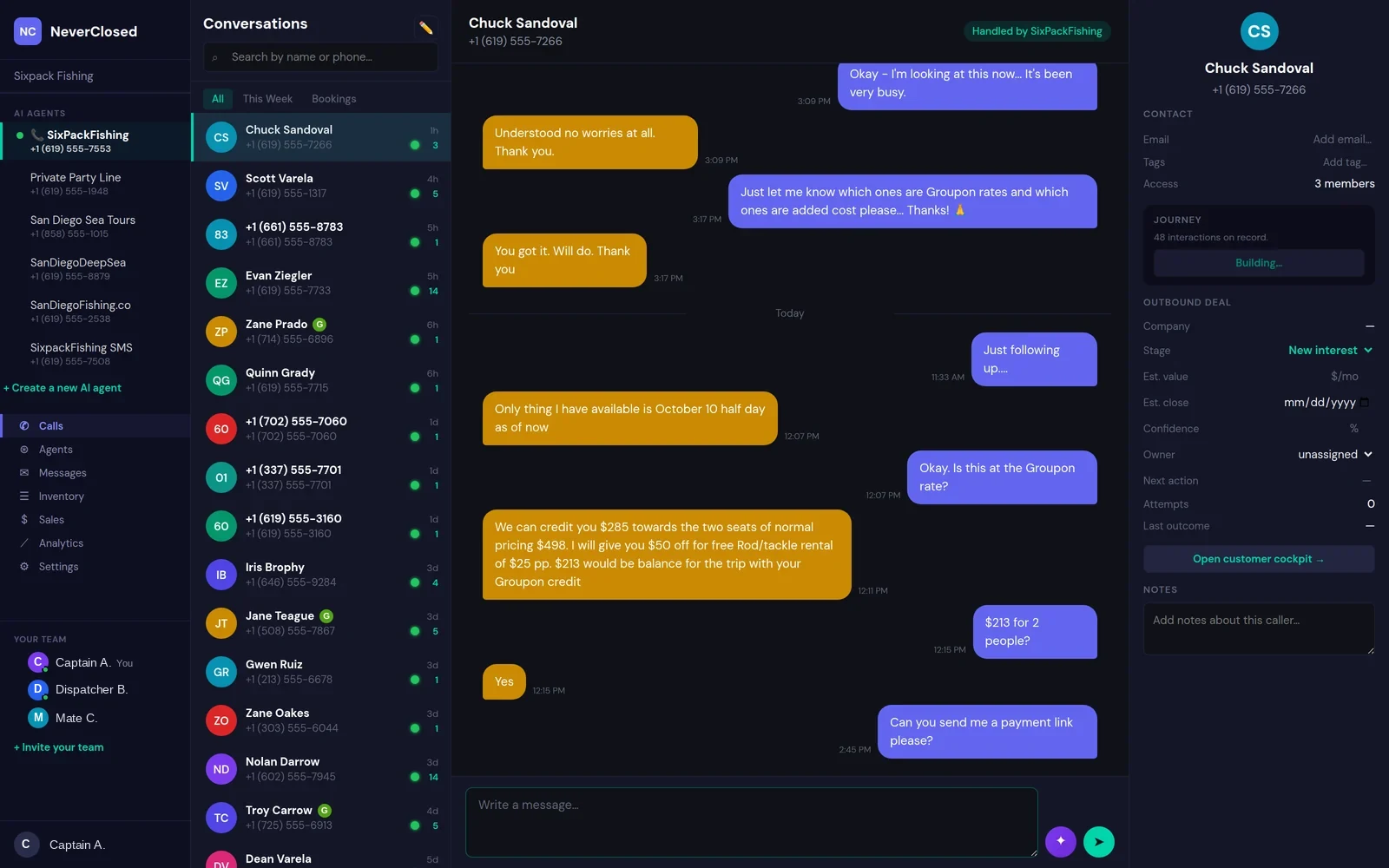
AI sounds too robotic for my business. You are thinking of the old system. Press one for sales. Your call is important to us. Please hold. That is not what modern AI phone agents do. They have real conversations. They understand context. They book appointments, take payments, and answer questions - in 26 languages. And they sound natural enough that most callers do not realize they are talking to AI. Customer satisfaction after switching to AI phone agents: 4.6 out of 5.
The Conversion Gap No One Talks About
Here's the uncomfortable truth about chatbots: most businesses implement them because they're the "obvious" digital choice, not because they actually convert better.
According to Forrester research, 84% of marketers report that phone calls have higher conversion rates with larger average order values compared to other forms of engagement. And caller retention rates are 28% higher than web lead retention.
This isn't because phones are magical, it's because the psychology of voice communication is fundamentally different from text.
Why Customers Call (Even When They Could Type)
Google's "Click to Call" research found that 59% of customers prefer to call because they want a quick answer, while 57% call specifically because they want to talk to a real person. These aren't mutually exclusive, many customers want both.
The industries where customers are most likely to pick up the phone tell the story:
Insurance
68% of customers call during their buying journey. Complex products with major financial implications.
Healthcare
67% call during their journey. Personal, sensitive, requires trust and immediate answers.
Home Services
60% call to schedule or get quotes. Urgency matters when the AC breaks.
Travel & Tours
53% call during booking process. High-value purchases with lots of questions.
Notice the pattern? These are all high-consideration purchases where customers have questions, need reassurance or are spending significant money. Tours and activities fall squarely into this category.
💡 The $33 Rule
Research suggests customers are more likely to call for purchases over $33. If your average booking is above this threshold and for most tour operators, it's well above, phone remains the preferred channel for closing sales.
The Chatbot Frustration Problem
Chatbots aren't inherently bad. They're just asked to do things they're not designed for and customers notice.
⚠️ Chatbot Customer Experience Data
And the business consequences are severe: 30% of customers say they're likely to abandon a brand entirely after a negative chatbot experience. Another 73% cancel ongoing purchases when chatbot interactions go poorly.
The average chatbot receives a rating of 6.4 out of 10 from customers, equivalent to a D grade. Not exactly the customer experience you want representing your business.
What Voice Can Do That Text Can't
The limitations aren't about technology, they're about the medium itself. Voice communication carries information that text simply cannot convey:
✓ Voice Advantages Over Text Chat
Dr. Albert Mehrabian's famous communication research found that when messages are ambiguous, tone of voice accounts for significantly more impact than words alone. For emotionally-charged moments, like planning a vacation, addressing a concern or making a purchasing decision, voice carries weight that text cannot match.
Real Scenario Comparison
Let's see how the same customer inquiry plays out across both channels:
📞 Scenario: Multi-Part Booking Question
"I want to book for 6 people, but my dad uses a wheelchair. Can you do a morning tour? And do kids under 10 get a discount?"
"I can help with booking! How many guests would you like?" [Forces sequential flow, misses context, may lose wheelchair accessibility question entirely]
"For 6 guests on a morning tour, let me check our 9 AM departure. We do accommodate wheelchairs on our main dock. And yes, kids under 10 are half price. Should I check availability for tomorrow?"
📞 Scenario: Anxious Customer
"I booked for tomorrow but I'm really worried about the weather. Should I reschedule? What happens if it rains?"
"For weather-related questions, please see our FAQ page or call us at [number]." [Customer frustration increases, may abandon]
"I completely understand the concern. Tomorrow's forecast actually looks good, partly cloudy with low chance of rain. But if weather does force a cancellation, we reschedule at no charge. Would you like me to confirm your current booking or look at backup dates just in case?"
📞 Scenario: On-the-Go Customer
Customer is driving to the marina, needs to book a last-minute charter for guests arriving that afternoon.
[Customer can't safely type while driving. Either pulls over (delay/friction) or doesn't engage at all. Booking lost.]
Customer calls hands-free, books in 90 seconds while driving. Payment link sent via SMS for completion after arrival. Booking captured.
The Accessibility Advantage
🎯 Voice Works for Everyone
Voice AI isn't just more effective, it's more inclusive. Research shows that older adults and people with disabilities consistently rate voice interfaces more positively than text-based alternatives.
For older adults, voice eliminates barriers associated with small screens, complex navigation and typing challenges. Studies show voice assistants offer "a user-friendly interface requiring minimal technological expertise, making them accessible to older adults with varying levels of digital literacy."
For people with visual impairments, motor difficulties or conditions that make typing challenging, voice provides equal access to your booking system. That's not just good ethics, it's good business, representing a significant customer segment that chatbots effectively exclude.
Head-to-Head Comparison
| Capability | Text Chatbot | AI Phone Agent |
|---|---|---|
| Conversion Rate | ~2% (web lead average) | 25-40% (phone lead) |
| Average Order Value | Lower | Higher (84% of marketers report) |
| Customer Retention | Baseline | 28% higher |
| Complex Questions | 75% say can't handle | Natural conversation flow |
| Emotional Nuance | Text only, easy to misread | Tone, pace, sentiment detection |
| Hands-Free Use | Requires screen + typing | Full hands-free operation |
| Accessibility | Challenges for many users | Natural for all ages/abilities |
| Trust Building | Impersonal | 87% feel more confident |
| Abandonment Rate | 67% when stuck in loops | Graceful escalation to human |
| Multi-Part Questions | Forces sequential flow | Handles naturally |
| 24/7 Availability | Yes | Yes |
| Setup Complexity | Simple | More involved (but worth it) |
When Chatbots Make Sense
This isn't an argument that chatbots are worthless. They have legitimate use cases:
- Simple FAQ deflection: "What are your hours?" "Where are you located?" "Do you accept credit cards?"
- Order status tracking: Looking up existing bookings with a confirmation number
- Low-value, low-complexity transactions: Items under $33 with no customization needed
- Lead qualification: Collecting basic info before routing to sales
- Asynchronous communication: When customers prefer to type at their own pace and don't need immediate answers
The problem isn't that businesses use chatbots. It's that they use chatbots as a replacement for voice, when they should be using them as a complement.
The ROI Math for Booking Businesses
Let's run the numbers for a typical tour operator:
📊 Monthly Comparison: Chatbot vs. Voice AI
At $200 average booking value, that's the difference between $300/month and $2,900/month in chatbot-influenced vs. voice-AI-influenced revenue. And this assumes the same level of engagement, when in reality, promoting phone as the primary contact method typically increases overall customer engagement.
The Verdict
💬 Chatbots Best For:
- → Simple FAQ deflection
- → Order status lookups
- → Basic lead capture
- → Low-value transactions
- → Asynchronous queries
📞 Voice AI Best For:
- ✓ Closing high-value bookings
- ✓ Complex, multi-part questions
- ✓ Emotional/anxious customers
- ✓ Building trust and confidence
- ✓ Accessibility for all users
- ✓ Hands-free, on-the-go booking
🏆 For Booking Businesses: Voice AI Wins
When the goal is converting interested prospects into paying customers, especially for tours, charters, reservations and high-consideration services, voice AI delivers 10-15x better results than text chatbots.
The Smart Strategy : Both, In Their Place
The most effective approach isn't choosing one or the other, it's deploying each where it performs best:
- Voice AI as primary booking channel: Make your phone number prominent. Route serious booking inquiries to voice where conversion rates are highest.
- Chatbot for simple queries: Keep a basic chatbot for FAQ deflection and order status. Don't try to make it close sales.
- Clear escalation paths: When chatbot hits complexity limits, route to voice immediately rather than frustrating the customer.
- Track both channels: Measure actual revenue attribution, not just "engagement" metrics that obscure the conversion gap.
The goal isn't to follow industry trends, it's to capture more bookings. And for booking-based businesses the data is clear: voice wins.
Ready to Hear the Difference?
Call our demo line and experience a voice AI agent yourself. Then ask: "Would my customers prefer this or typing into a chat window?"
Try Live Voice Demo